Main content
Course: Organic chemistry > Unit 7
Lesson 8: Thiols and sulfidesPreparation of sulfides

How to prepare sulfides from thiols. Sulfides are like ethers, but with a sulfur instead of an oxygen atom. Created by Jay.
Want to join the conversation?
 At about0:45, Jay compared thiols and sulfides to alcohols and esters. The difference is that Sulfur is directly below Oxygen on the Periodic Table, therefore they have similar properties and react in a related manner.
If we look at the Periodic Table, we see that Silicon is directly below Carbon. Is there a silicon-based chemistry analogous to the carbon-based chemistry that is organic chemistry? I know that some science fiction uses silicon-based life forms. I'm not expecting this to evolve into a branch of biochemistry, but is there a branch of chemistry based in Silicon that mirrors organic chemistry?(13 votes) The chemistry of silicon is similar but not identical to that of carbon.
Like carbon atoms, silicon atoms can join together to form chains. As in hydrocarbons, these chains (called silanes) progressively grow in length as additional silicon atoms are added. But there is a very quick end to this trend. The largest silane, called hexasilane, has six silicon atoms (Si6H14 compared to C6H14).
Hexasilane is the largest possible silane because Si-Si bonds are not particularly strong. In fact, silanes are rather prone to decomposition by reaction with oxygen.Think of the stability of SiO2 (sand).
Silanes also have a tendency to swap out their hydrogens for other elements and alkyl groups and become organosilanes. An example is dichlorodimethylsilane, (CH3)2SiCl2.
There are chemists who spend their lives studying the chemistry of silicon, but silicon chemistry does not mirror organic chemistry, mainly because the Si-Si bonds are so weak.(19 votes)
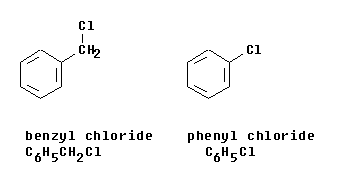
 When naming the last product, are the names "benzyl" and "phenyl" synonomous?(4 votes)
 No, its kind of odd, actually. This picture comparison explains it better than I can: http://bbruner.org/obc/phen_fig/phenyl2.gif(6 votes)
- Can these reactions also occur through the SN1 mechanism if we have a tertiary alkyl group attached to a good LG?(2 votes)
- A base like S- would give an E2 reaction as the major product on a tertiary alkyl group with a good leaving group. Under solvolysis conditions(solvents that are not bases), SN1 and E1 reactions could occur, but these are more of a theoretical reaction since performing them in the lab gives a mixture of products.(2 votes)
 Are there any other reactions like this that can be replaced with a thiol instead of an alcohol, as in stated at0:48which forms a similar product to the original one in organic chemistry?(2 votes)
 What is ideal reaction medium or solvent for the above reaction ? Guessing should it be something that is both polar but not water, like butanol ?(2 votes)
 The thiol is tertiary carbon but how can it be SN2 mechanism?(2 votes)
 For this reaction, the thiolate ion is acting as the reagent (or the nucleophile) and the alkyl halide is the substrate (or the molecule to accept the attack of the nucleophile). It is the substrate in a SN2 reaction which should not be tertiary to promote this type of reaction since bulkier groups will block the nucleophile's attack. Here the alkyl halide substrate is primary so it'll be a good substrate for SN2.
Side note: not that it matters, but the thiol is secondary since the carbon bearing the sulfur is bonded to two other carbons.
Hope that helps.(1 vote)
 There was a question which i couldn't solve...
A black mineral A on heating in air gives a gas B.The mineral A on reaction with H2SO4 gives a gas C and a compound D.Bubbling C into an aqueous solution of B gives white turbidity.The aqueous solution of compound D, on exposure to air with NH4SCN gives a red compound E.The compounds A and E are?
a) PbS and Pb(SCN)2
b)NiS and Ni(SCN)2
c)FeS and Fe(SCN)2
d)CoS and Co(SCN)2
After solving a bit I think B is SO2 and C is H2S...and aqueous solution of B would mean H2SO3 or H2SO4.And all the four sulphides in the answer options are black in colour.(2 votes)- Is there any particular way to remember that sulfide is a functional group and not exactly a Sulfer anion? I understand what sulfide is and all that but I keep getting confused when I hear sulfide because I automatically think of S- instead of R-S-R'. Just wondering if there is a simple way to think about it?(2 votes)
 At5:25does the phenyl thiolate have resonance? If so, what are the consequences of that for the reaction?
(The same question could be asked for phenyl with an O-, instead of S-)(2 votes)- To my knowledge it would have resonance. I know phenoxide has resonance because the O⁻ is a strongly electron donating substituent. To see a similar example in action, see https://www.khanacademy.org/science/organic-chemistry/aromatic-compounds/directing-effects/v/ortho-para-directors-i and skip to about5:07, when Jay is showing the how the methoxy group can help to stabilize the molecule when a nitro group has been added ortho to it. I think the phenyl thiolate would also have resonance, though my gut is telling me that the resonance wouldn't be as impactful compared to an oxygen atom due to poorer overlap of sulfur's orbitals with carbon due to the size mismatch in atoms.
Nevertheless, due to the resonance that sulfur would have with the aromatic ring, sulfur would activate the ring (making it more nucleophilic and cause electrophilic aromatic substitution to occur faster), cause substituents to add ortho- and para- to the thiolate in electrophilic aromatic substitution, and finally shield the carbons and hydrogens in the ring during NMR, decreasing their chemical shifts.(1 vote)
- What would be the IUPAC name for ethyl-phenyl-sulfide?(1 vote)
 It is a "Thiophenetole". This site might good for you to find IUPAC name with a structure.
http://web.chemdoodle.com/demos/iupac-naming(2 votes)
 0:45
0:45
Video transcript
Let's look at how to prepare
sulfides from thiols. So over here on the
left, I have my thiol. And to that thiol, I'm going
to add sodium hydroxide. And the sodium
hydroxide is going to deprotonated the
thiol, which is then going to react with this alkyl
halide in the second step of the reaction, to produce
my sulfide as my product. So here's my sulfide right here. This reaction is the analog of
the Williamson ether synthesis, which we've seen
in earlier videos. So in that video, we
started off with an alcohol, and we reacted our alcohol with
a strong base in the first step and an alkyl halide
in the second step, and we formed an
ether as our product. So we can go ahead and draw
our ether in here like that. So the thiol is the sulfur
analog into an alcohol, and a sulfide is the
sulfur analog to an ether. Let's look at the
mechanism to make sulfide. So if I start with
my thiol right here-- so I have carbon bonded
to sulfur bonded to a hydrogen. And then two lone pairs of
electrons on that sulfur. And if I think about the
difference in electronegativity between carbon and
sulfur, there's actually not much of a
difference in terms of numbers. So this is not a very
polar bond actually. That's different from what
we see with an alcohol. So up here, if we
look at the alcohol, I know that oxygen is much more
electronegative than carbon. So this oxygen here would
get a partial negative. And this carbon on the
left that it's bonded to would get a partial positive. So there's much more of an
electronegativity difference in alcohols. In thiols, there's not really
that much of a difference. But thiols can still
function as nucleophiles because these lone
pairs of electrons are located further
away from the nucleus than the lone pair of
electrons in oxygen, because sulfur is a larger atom. So those electrons
are more polarizable, and so thiols are actually
excellent nucleophiles. So if we go back here
to our mechanism, we're now going to add sodium
hydroxide, which is a base. So we can go ahead and
put OH minus over here. So the hydroxide anion is
going to function as a base. And a lone pair of electrons
are going to take this proton and leave these electrons
behind on the sulfur. So let's go ahead and draw the
conjugate base to the thiol. So we now have carbon
bonded to sulfur, and this sulfur now has three
lone pairs of electrons, giving it a negative
one formal charge. So this is called
a thiolate anion. So let me just go
ahead and write that. And thiolate anions
are very stable. That negative charge on
the sulfur-- since sulfur is a large atom,
you can spread out that negative charge
over a very large area. So the thiolate anion
is relatively stable, and that makes thiols
more acidic than alcohols. OK? So alcohols don't have the
same type of stabilization since alcohols are smaller. So thiols are
actually very acidic, and that's why we can
use sodium hydroxide here to deprotonated our thiol
to form the thiolate anion. In the second step, we
add our alkyl halide. And so here's my alkyl halide. And the alkyl halide does
have a polarized bond, right? The difference in
electronegativity between a halogen a carbon
atom is fairly large. So this halogen here is going to
get a partial negative charge. And this carbon is going to
get a partial positive charge. So thiols are good nucleophiles. Thiolate anions are even
better nucleophiles. And so the thiolate
anion is going to function as the nucleophile. The partially positive
carbon is going to function is the
electrophile, and we're going to get an SN2
type mechanism, where our strong nucleophile
attacks our electrophile and kicks these electrons
off here onto the halogen. And we can go ahead
and form our product. So this is an
SN2-type mechanism. And we end up with the sulfur
now bonded to two R groups. And they could, obviously,
be the same R groups. Or they could be
different R groups. And so we've formed
our sulfide like that. Let's do an example of the
preparation of sulfide. So we're going to
start with-- let's see. Let's start with
this one right here. All right. So we start with this molecule. And to that thiol, we're
going to add sodium hydroxide in the first step. So let's go ahead and write
sodium hydroxide here. A Na plus and then
OH minus like that. And then, in the
second step, we're going to add an alkyl halide. So let's add this as our alkyl
halide-- so ethyl bromine. So when I think
about the mechanism, I know the first step is
an acid base reaction. The electrons on the
hydroxide anion-- so one of these electron
pairs here-- are going to take this
proton-- that's the acidic proton on my thiol--
leaving these electrons behind on the sulfur. So I can go ahead and draw
the resulting thiolate anion. So I can go ahead and draw that. Let me see what we have here. We have our ring, and
then we have our sulfur. And our sulfur now
has three lone pairs of electrons around
it like that. Thiolate anions are
excellence nucleophiles. And when I look at
my alkyl halide, once again, I know the
electronegativity difference between bromine and
this carbon here. I'm going to give bromine
a partial negative charge. This carbon is going to
be partially positive. So the thiolate anion's going
to act as a nucleophile. And an SN2-type mechanism
and a lone pair of electrons, here, are going to
attack my electrophile. And we can go ahead
and form our product. So now we have our
ring here, which is connected to our sulfur. And our sulfur, now, just
picked up 2 more carbons, right? Because these
electrons in here are going to kick off
onto the bromine, and we end up putting an
ethyl group onto that sulfur. So there are 2 carbons now
on that sulfur like that. And the sulfur has 2
lone pairs of electrons. And so we formed our sulfide. Now, if I were to
name this sulfide, it's a lot like naming ethers. So I could use the
common way of naming this and treat those as alkyl groups. And if I look on the right,
this would be an ethyl group. So I could go ahead
and start naming it. I could say it's
ethyl-- and if I look at the alkyl group
on the left side-- this is a phenyl
group, right here. So it's ethyl. And then phenyl
since I'm calling the alphabet rule
here-- e before p. And then finally, I
know it's a sulfide. So I can just go ahead and
finish the nomenclature by saying sulfide here. So ethyl phenyl
sulfide is the sulfide produced in this analog of the
Williamson ether synthesis.